

Bitcoin climbed back to $78,000 on April 21 after sharp intraday swings driven by geopolitical and monetary developments.
The price fluctuated between $75,000 and $77,000 as traders reacted to updates on Iran ceasefire discussions.
Market sentiment shifted quickly following conflicting signals around diplomatic talks. Bitcoin later recovered as investors reassessed risk and policy outlook.
Bitcoin volatility driven by ceasefire developments
Bitcoin started the day with gains, reaching $76,944 during early trading hours.
Reports indicated that US negotiators traveled to Islamabad to continue discussions with Iranian counterparts.
The developments followed statements linked to Donald Trump regarding an extension of ceasefire efforts.
However, uncertainty emerged after conflicting reports questioned Iran’s participation in the talks.
This triggered a rapid sell-off, pushing Bitcoin to an intraday low of $75,085 by early afternoon. Traders reacted quickly to the mixed signals, increasing volatility across the market.
As the session progressed, Bitcoin rebounded above $75,500 before climbing toward $78,000. The volatile conditions caught many leveraged traders off guard.
The turbulent market conditions caught 6,769 traders off guard.
Approximately $97 million in leveraged contracts were forcibly closed, with short positions accounting for $62.45 million, representing roughly 64% of total liquidations.
Fed signals and market metrics support recovery
Investors also focused on testimony from Kevin Warsh before the Senate Banking Committee.
Warsh stated that Federal Reserve decisions would remain independent of political pressure. He clarified that no prior agreement existed on immediate interest rate cuts.
His remarks followed public comments from Trump, who had expressed expectations for rate reductions. Warsh’s position signaled a cautious approach, which initially weighed on risk assets, including cryptocurrencies.
Crypto-related stocks reflected the pressure during the session. Coinbase declined more than 6%, while Circle dropped 8.3%. Galaxy Digital fell 5.5%, and Robinhood slipped 4.5%.
Despite this, on-chain indicators suggested strengthening market conditions.
Bitcoin’s Spent Output Profit Ratio reached 2.87, an eight-month high. The market bottom likely formed in February, with a rally already underway.
Bitcoin’s Net Unrealized Profit/Loss metric also turned positive for the first time since early January.
Looking ahead, resistance stands near $84,000, where around 1.1 million BTC were previously acquired.
The $83,100 average entry point for US spot Bitcoin ETFs also presents a key barrier. Bitcoin’s market capitalization remains above $1.51 trillion as it holds near $78,000.
Bitcoin surges toward $80K as bullish momentum strengthens
The 1-day chart for Bitcoin price shows a clear bullish trend in the most recent sessions, with price action forming higher highs and higher lows after recovering from a dip.
Buyers have steadily regained control, pushing the market upward toward the upper resistance zone.
The current price is around $78,100, with the latest daily candle closing strongly near its high.
This suggests sustained buying pressure and momentum continuation, especially as the price approaches the $80,000 psychological level.
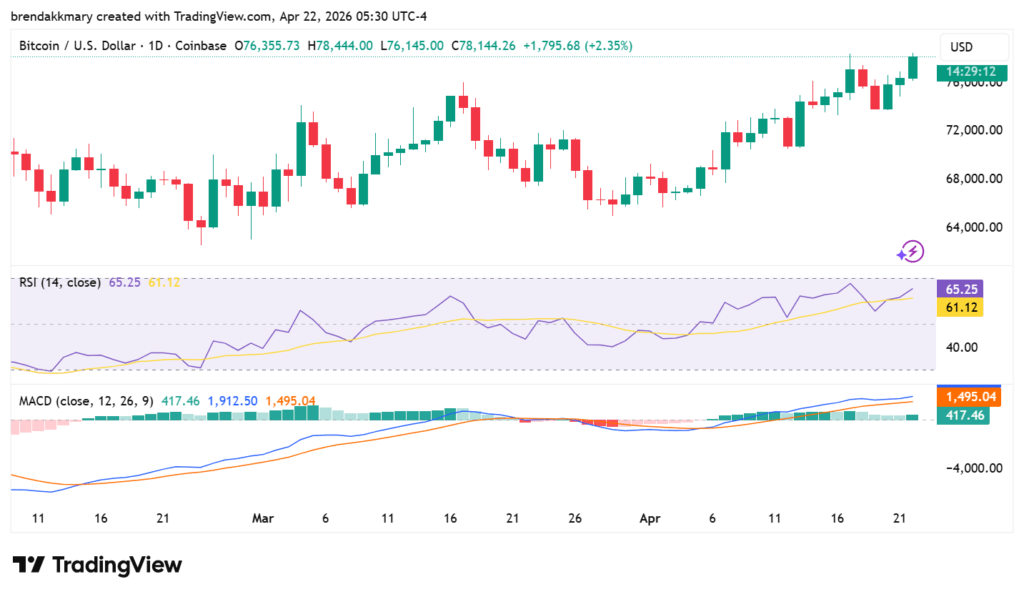
Looking at the indicators, the Relative Strength Index (RSI) is around 65, which indicates bullish momentum without being overbought yet.
The MACD remains in bullish territory, with the MACD line above the signal line and positive histogram bars.
This confirms the ongoing upward momentum and supports the continuation of the current uptrend.