

ZeroLend has announced the shutdown of its operations after three years in the decentralized finance space.
The protocol’s leadership stated that continuing operations is no longer viable, citing structural challenges that have steadily eroded its effectiveness.
Why ZeroLend is winding down
ZeroLend’s closure follows a period of sharp contraction, during which user activity and capital inflows dropped across many of the blockchain networks it supported.
At its peak in 2025, the protocol managed hundreds of millions of dollars in locked assets, but that figure declined dramatically as market conditions shifted.
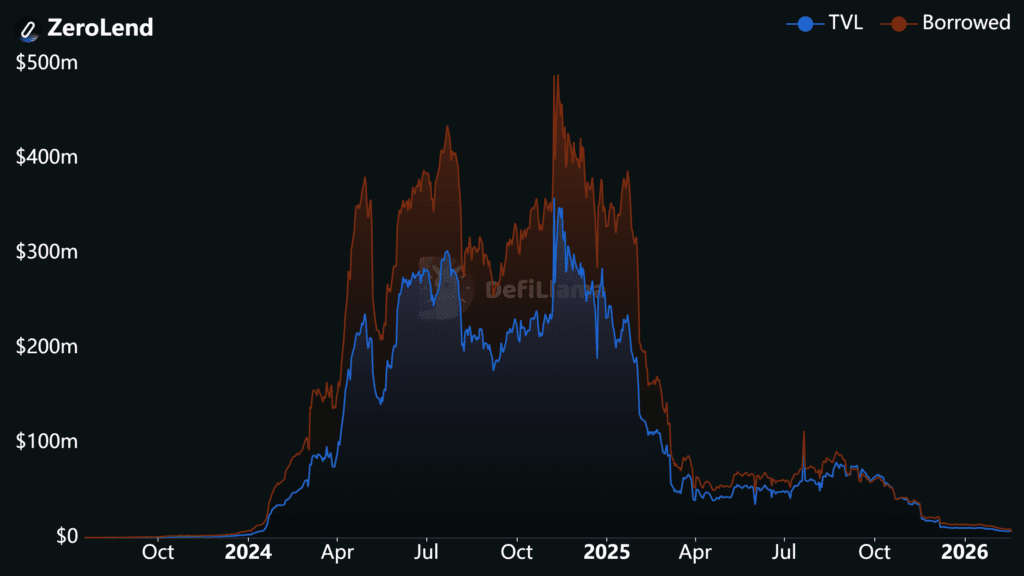
The shrinking base of active users made it increasingly difficult to maintain healthy crypto lending markets across multiple chains.
Liquidity fragmentation emerged as one of the most serious issues facing the protocol.
Many supported networks lacked sufficient trading volume, making it hard to balance supply and demand for loans.
As liquidity thinned, crypto borrowing and lending became less efficient, reducing incentives for users to stay engaged.
These challenges were compounded by technical dependencies that became harder to sustain.
Price data providers and Oracle services began discontinuing support for certain low-activity networks.
Without reliable price feeds, maintaining secure and functional lending markets became increasingly risky.
Security concerns also weighed heavily on the protocol’s future.
As DeFi platforms grow, they tend to attract greater attention from malicious actors.
Operating across many chains increased the surface area for potential exploits and scams.
At the same time, profit margins in decentralized lending remained extremely thin.
Operational costs continued to rise even as revenues declined.
The team acknowledged that the protocol had been running at a loss for extended periods.
Under these conditions, sustaining development, audits, and risk management became impractical.
Gradual wind-down and user protections
Rather than shutting down abruptly, ZeroLend initiated a controlled wind-down process.
New borrowing has been disabled across the platform.
Loan-to-value ratios on most markets have been set to zero, effectively halting lending activity.
This approach allows users to focus solely on withdrawing their remaining funds.
The team has strongly encouraged all users to remove assets as soon as possible.
Most withdrawals remain available, although assets on low-liquidity chains may face delays.
To address this, the developers indicated that smart contract updates may be deployed to assist with fund recovery where feasible.
The goal of this process is to minimize disruption while ensuring users retain access to their assets.
Despite these measures, the shutdown has had immediate market consequences.
The protocol’s native token experienced a sharp decline in value following the announcement.
This reaction reflected reduced confidence in the project’s long-term prospects.