
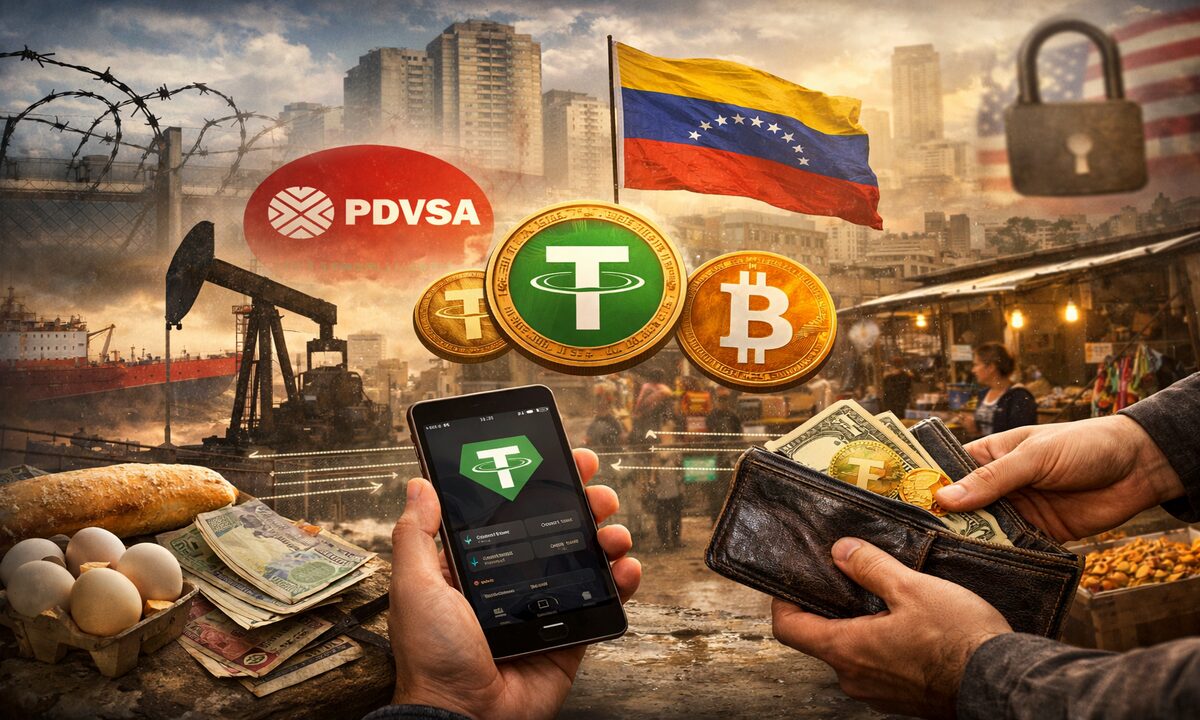
Venezuela continues to rely on digital alternatives as sanctions and economic collapse reshape daily life and trade.
Even after the arrest of former president Nicolás Maduro, financial pressure has not eased.
Instead, workarounds outside traditional banking have expanded. USDT Tether now plays a central role in oil trade and household payments.
USDT keeps Venezuela’s oil trade moving under sanctions
Venezuela turned to USDT after US sanctions disrupted standard banking channels.
Those measures, imposed in 2020, pushed foreign banks out and weakened domestic financial infrastructure.
As a result, Petróleos de Venezuela sought alternative settlement methods for oil sales.
Economists reported that the state-run oil company began accepting USDT to bypass failing banks.
Buyers transferred funds directly between digital wallets.
Some set up dedicated addresses for oil transactions, while others relied on exchange intermediaries.
This system allowed shipments to continue despite blocked payment routes.
About 80% of Venezuela’s oil revenue flowed through digital currencies during this period.
Public blockchain records helped firms track transfers and maintain internal accounting.
However, US officials later monitored these transactions and coordinated with Tether. They froze several wallets tied to oil payments after detecting irregular activity.
Investigators reportedly used blockchain data to trace funds linked to the Maduro government.
Despite these actions, economists said oil trading via USDT continued. Businesses viewed it as the only viable option under sanctions and a broken banking system.
Hyperinflation pushes Venezuelans toward USDT for daily payments
Venezuelans also adopted USDT for everyday survival as hyperinflation eroded the bolivar. Prices for food, transport, and services rose daily.
Wages stayed flat, leaving families unable to afford essentials. Over more than a decade, the national currency lost most of its purchasing power.
Economists said people abandoned the bolivar after watching savings disappear.
Many turned to USDT because it tracked the US dollar closely. The stablecoin market helped preserve value and enabled cross-border transfers.
Families abroad used it to send support quickly and cheaply.
Over time, USDT moved beyond savings into daily commerce. Residents used it to pay rent, haircuts, cleaning services, and home repairs.
Shop owners and service providers accepted USDT, citing stability concerns with the bolivar.
Despite lacking clear regulations or official exchanges, communities shared knowledge on digital wallets.
The adoption grew from necessity, not enthusiasm for technology. Capital controls and cash shortages further pushed people toward stablecoins.
The government’s failed Petro project reinforced public distrust in state-backed digital money.