
Lido DAO is considering a significant intervention to support its native token, LDO, by proposing a buyback program worth up to $20 million.
The proposal comes at a time when the token’s market value has diverged sharply from the protocol’s underlying performance, raising concerns among stakeholders about long-term alignment.
Why Lido DAO wants to buy back LDO
The proposal, put forward by Lido’s ecosystem contributors, suggests using up to 10,000 stETH (staked Ether) from the treasury to repurchase LDO tokens from the open market. At current prices, this equates to roughly $20 million.
According to the DAO, LDO is trading at historically low levels relative to Ether, with its LDO/ETH ratio down around 60–70% compared to its typical range over the past two years.
This disconnect has been described as a “price dislocation,” where the token’s valuation no longer reflects the protocol’s fundamentals or market position.
Scale and structure of the buyback
If approved, the buyback could absorb tens of millions of LDO tokens, potentially around 8% of the circulating supply.
Rather than executing the purchase all at once, Lido plans a gradual approach:
- Funds would be deployed in batches of about 1,000 stETH.
- Each tranche would require governance approval.
- Strategies like limit orders or dollar-cost averaging would be used to minimize market disruption.
This cautious execution reflects an effort to avoid sudden price swings while maintaining transparency and community oversight.
Financial pressures behind the move
The buyback proposal comes after a challenging financial year for Lido. The protocol reported $40.5 million in revenue for 2025, marking a 23% year-over-year decline, largely due to reduced staking fees.
Other key metrics have also weakened, with:
- Staking rewards falling roughly 20%.
- Total value locked (TVL) declining in ETH terms.
- Market share in Ethereum staking slipping slightly amid rising competition.
Despite this, Lido argues that its core business remains strong. Operational efficiency improved, costs dropped, and its fee capture (take rate) increased to over 6%, indicating better monetization of staking activity.
LDO price decline despite Lido dominating liquid staking
Lido continues to dominate Ethereum’s liquid staking sector, controlling roughly 23% of all staked Ether.
However, this dominance has not translated into LDO’s token performance. LDO remains down more than 95% from its 2021 peak and has recently hovered near all-time lows around $0.30 despite gaining about 11% over the past seven days.
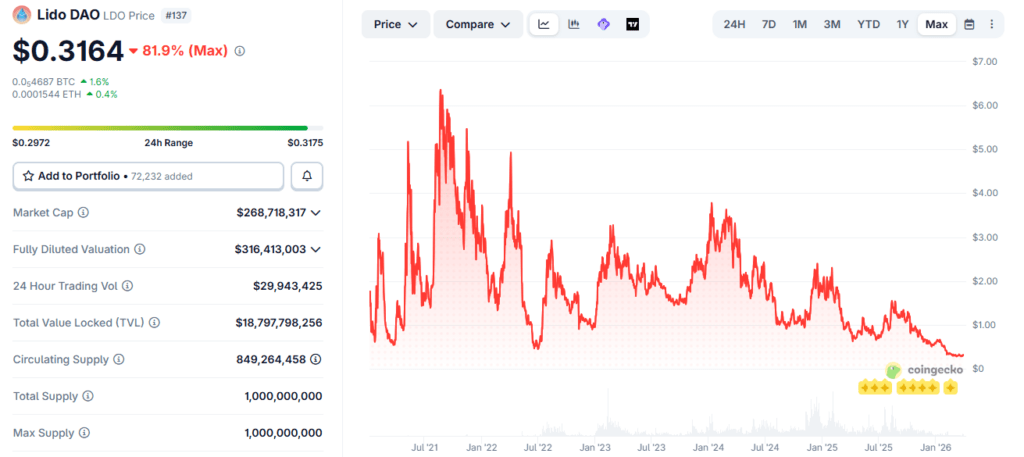
This gap between protocol success and token price has become a central issue in the Lido ecosystem. Analysts increasingly point to weak tokenomics and declining investor confidence, especially among large holders, as contributing factors.
Will the buyback help LDO recover?
A buyback of this size could provide short-term support by:
- Reducing circulating supply.
- Improving liquidity conditions.
- Signaling confidence from Lido DAO.
However, its long-term effectiveness is far from guaranteed.
Market observers note that price recovery will depend on broader crypto trends, particularly Ethereum and Bitcoin movements, as well as execution quality and investor sentiment.
But there are also risks:
- Misuse of treasury funds could undermine trust.
- Continued selling by large holders may offset buyback effects.
- Structural tokenomics issues may persist even after supply reduction.
However, the proposed buyback is not an isolated move. Lido is exploring longer-term mechanisms, including:
- Automated buybacks tied to protocol revenue.
- Expanded product offerings like institutional staking vaults.
- New yield-generating services to diversify income.
These efforts aim to better connect the protocol’s economic success with LDO’s value, something critics argue has been missing.
The bottom line
While the plan could offer temporary relief for LDO’s price, its success will ultimately depend on whether Lido DAO can fix deeper structural issues, particularly how value flows from the protocol to token holders.