

Bitcoin has dropped sharply over the weekend as escalating tensions between the United States and Iran rattled global markets.
The decline followed the collapse of diplomatic talks and a confirmed naval blockade in the Strait of Hormuz.
The cryptocurrency lost ground after briefly holding above $73,000, reflecting heightened geopolitical risk.
As a result, Bitcoin slipped into a contested trading range amid rising energy prices and macroeconomic uncertainty.
Geopolitical tensions trigger sharp Bitcoin pullback
Bitcoin traded above $73,000 for most of Saturday before reversing course.
The decline followed remarks from US Vice President J.D. Vance, who confirmed failed negotiations in Pakistan. He stated that the United States negotiated in good faith and presented its best offer to Iran.
Shortly after, President Donald Trump confirmed a naval blockade targeting the Strait of Hormuz through Truth Social. He attributed the move to Iran’s refusal to halt nuclear weapons development.
Following the announcement, Bitcoin dropped to around $70,900, marking a 2.5% decline within 24 hours.
The asset extended losses to $70,623 as US futures markets opened on Sunday. At the time of reporting Monday morning, Bitcoin is trading near $70,826, consolidating within a structurally contested range.
Each move into the $70,000–$80,000 zone has triggered consistent profit-taking, exceeding $20 million per hour during the previous rally.
Meanwhile, crude oil surged sharply. Prices jumped 9.5% to $105 per barrel within 30 minutes of market activity.
Brent crude reached $98 on Monday, reflecting continued geopolitical risk in energy markets.
Institutional demand supports Bitcoin amid macro pressure
Despite the decline, Bitcoin avoided a panic-driven sell-off. About 13.5 million Bitcoin addresses remain underwater at current levels, limiting aggressive selling.
Institutional demand provided underlying support. Blockhead Research Network reported $240 million in net Bitcoin ETF inflows last week.
Ethereum followed with $187 million in inflows, signaling renewed investor interest after inconsistent demand periods.
At the same time, softer core inflation and thin supply between $72,000 and $80,000 suggested potential upside.
However, the Hormuz blockade complicated that outlook. The Strait handles a significant portion of global oil supply, raising concerns about energy-driven inflation.
The Federal Reserve raised its 2026 inflation forecast to 2.7%, reducing expectations for near-term rate cuts. Upcoming producer price index data and Federal Reserve commentary are expected to guide market direction.
Bitcoin consolidates near $70.8K as momentum gradually improves
Bitcoin price is trading in a sideways consolidation after a sharp drop, with price holding between $65,000 and $75,000.
Higher lows are forming, signaling gradual recovery momentum, while the current price is around $70,800.
Recent candles show mild bullish pressure, but a clear breakout has not yet occurred.
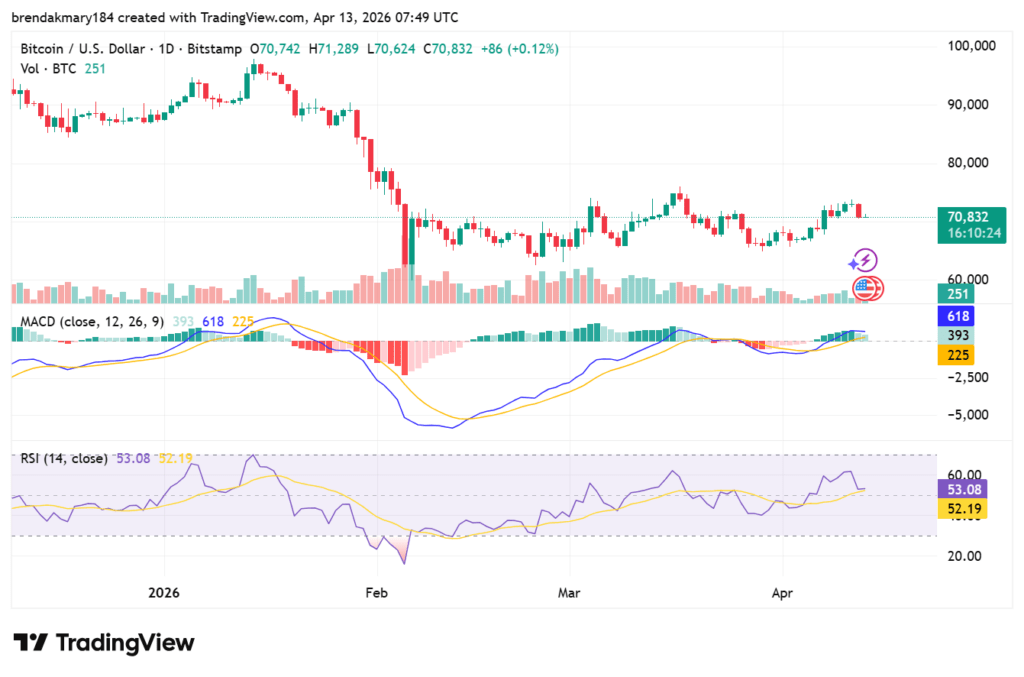
The MACD shows a bullish crossover with the histogram turning positive, indicating improving momentum, although strength remains moderate.
The RSI is around 53, reflecting neutral conditions with a slight bullish bias, as the market is neither overbought nor oversold.