

Aster has slashed its monthly token emissions by over 97%, marking a decisive shift in its tokenomics model.
The platform replaced its fixed distribution schedule with a staking-driven framework to control supply growth.
The adjustment directly targets concerns around token dilution and persistent sell pressure. It also signals a broader move toward rewarding long-term participation over short-term liquidity.
Aster restructures emissions around staking incentives
The platform lowered its monthly ASTER distribution from 78.4 million tokens to between 1.8 million and 2.25 million. Previously, Aster released about 1% of its total 8 billion supply each month.
The revised structure sharply limits new tokens entering circulation. The shift aligns rewards with long-term network participation.
Ecosystem tokens now flow directly into staking rewards. Around 450,000 ASTER tokens are distributed in each weekly epoch.
The design encourages users to lock tokens for higher returns. Longer commitments unlock greater rewards through an engagement-based system.
The Ecosystem and Community allocation, which represents 30% of total supply, now anchors this model.
Beyond staking, the pool supports APX-to-ASTER migration, development grants, promotions, and liquidity programs.
The staking framework introduces two reward layers. A 150,000 ASTER Base APY component forms the foundation.
On top of that, a 300,000 ASTER Loyalty Rewards pool boosts earnings. Rewards increase based on lock duration and overall platform activity.
Supply controls, buybacks, and deflation outlook
The Aster Foundation treasury, which holds 7% of total supply, remains locked. Governance processes will determine how and when those tokens enter circulation.
Team allocations account for 5% of supply and follow a 12-month cliff. Afterward, tokens unlock gradually over 40 months.
Airdrops make up over 53% of the total supply. During the September 17, 2025, token generation event, 8.8% became immediately available.
The remaining tokens will unlock over 80 months, limiting sudden supply shocks.
A buyback mechanism introduced in December continues to operate alongside these changes. Up to 80% of daily trading fees go toward purchasing ASTER from secondary markets.
Combined with lower emissions, this structure could shift the token toward a deflationary path.
The platform also launched Aster Chain, its proprietary Layer-1 blockchain, earlier this month.
The network focuses on privacy and performance tailored for derivatives trading. Aster positions itself against competitors such as Hyperliquid and Lighter.
ASTER technical analysis
Looking at the 1-day Aster price chart, the token has been trading in a sideways pattern near $0.66.
Short-term price movement shows consolidation, with neither bulls nor bears asserting strong control. Volume has steadily decreased, suggesting low trading interest and potential indecision.
At the time of writing, ASTER is trading at $0.6607, down nearly 1.59% over the past 24 hours.
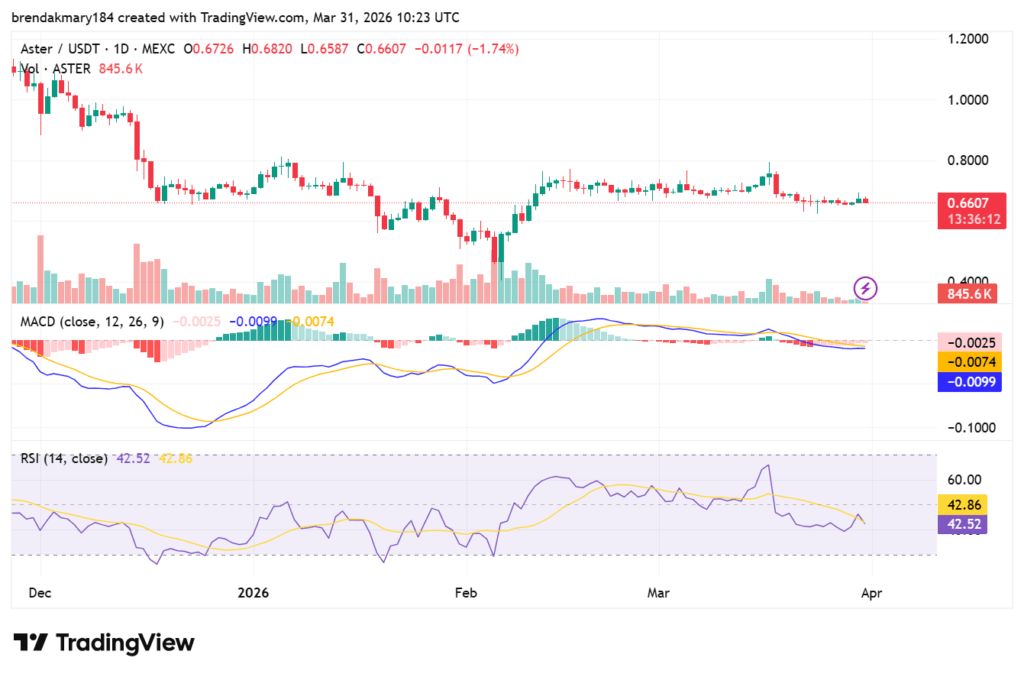
ASTER 1-day price chart, Source: TradingView
The MACD shows the lines below zero, with the blue line slightly under the orange signal line, indicating weak bearish momentum.
Meanwhile, RSI is at 42, below the neutral 50 level, signaling mild selling pressure but no oversold condition yet.